I want to be more methodical on this one. Let's talk about the Notice Kit and how it came to be.
IKEA Cash Register
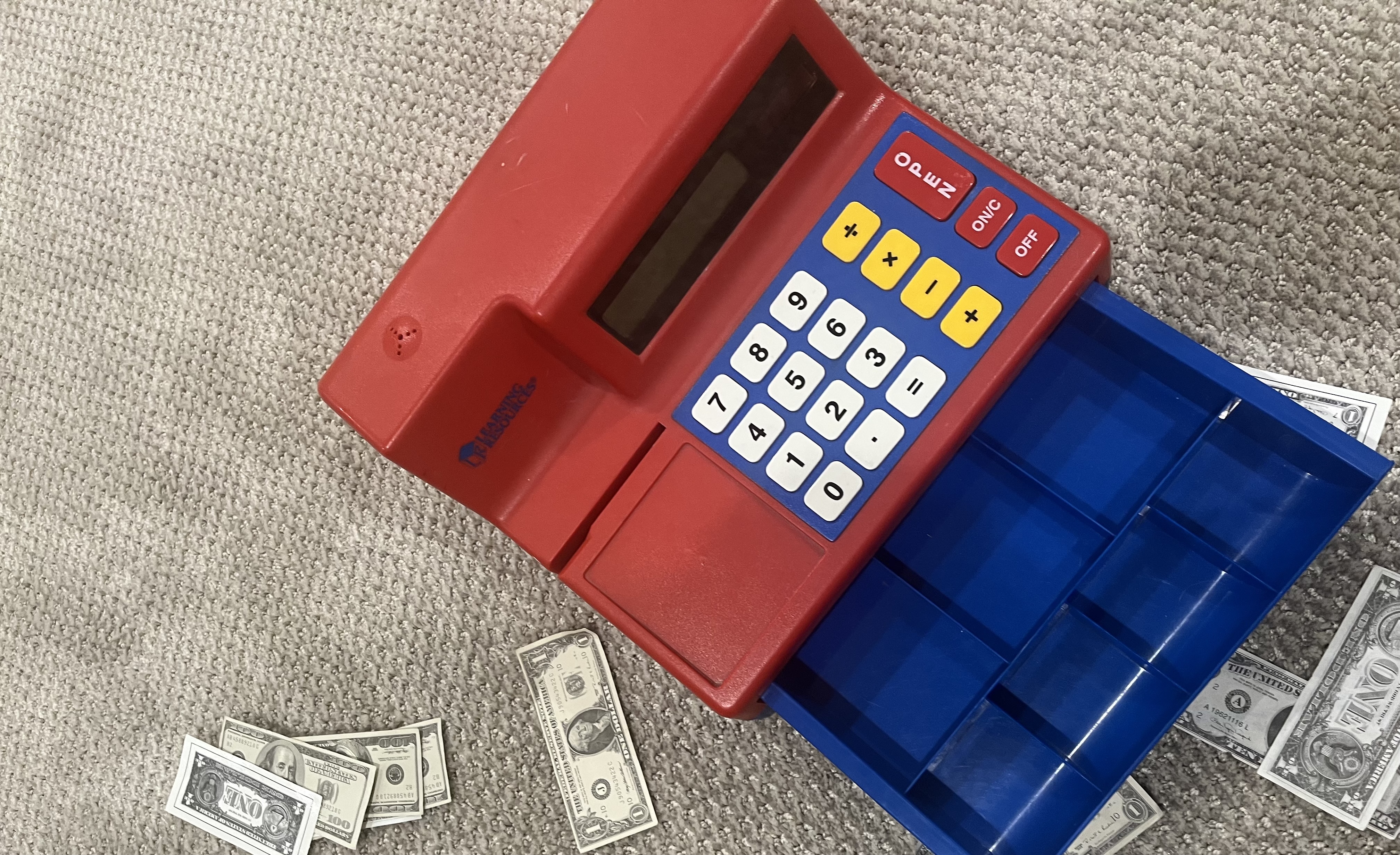
My son has one of those IKEA cash registers. It's a piece of plastic and a couple pieces of wood and acts like a register but is really just as a calculator. I'm sure you know the one even if you've never been to IKEA. There are slots for coins and little buttons for cash or card, etc. But it's not practical. For a kid, it doesn't really allow you to work out how it should work. Also, in today's era, you barely even see the register when there is a huge LED screen in front of you with all your items in picture form and if you use self checkout, forget the idea of thinking someone's on the other side of the transaction.
Monopoly Money
I love Monopoly. Whenever someone wanted to play, I was down. I was also terrible at playing. I would buy the first thing I could. That was the strategy. Sometimes that worked, most times it didn't. But the thing I remember was the money. Different colored money. I don't know if the original landlord game had that, but I thought it was helpful to easily know: do I give a white or pink one, and I don't want to ever spend the gold one. Colors mattered to make it easier and less dependent on math. Early on, we got feedback asking why not just use Monopoly to teach kids about money. You could... play the game, give little lessons on how it works in the real world. But at the end of the day, Monopoly is about winning and losing. Money isn't. Money doesn't care if you win or lose. It's just money. And the idea of winning or losing in the way Monopoly sees the world... well, I'll let you draw your own conclusions.
George Constanza's Wallet
The wallet and purse have changed quite a bit, haven't they. I remember as a kid just wanting to have a metal clip with a FAT wad of ...ones and a $5 on the outside. Felt like a big deal then. Then when I was older I remember seeing George Constanza's wallet and thought I definitely don't want that. I suppose quite a few other young men and I grew up feeling something against their fathers' wallets because slim card cases became the norm. It's also likely because we needed a lot fewer 1s and 5s too. Anyway, I also remember the kids with the Velcro wallets. You know the ones. Those were special. They had cool colors and were easy to use for kids. I would've been okay with one of those, and then George ruined it for me. But let's be honest- when a purse or wallet comes to mind... it's not an easy thing to translate to a kid. The kid doesn't have real connection to something that abstract or meaningful. They just know you open it for a card, grab a piece of paper or gum, or that it's stuck to your phone or also where mama's sunglasses are kept. Their understanding is stuck thinking it's YOURS, not theirs. We needed something specific for a kid. Something not for an adult. For small hands and yet something seriously gen Alpha.
Target Receipts
There are a lot of reasons I think this is important in this day and age, but let me start with a memory. I remember buying a shirt from Target when I was a teenager. Now, at the time, Target had a very different stance on returns. In fact, if you opened it or if it was something like a shirt where I could've worn it- they weren't taking it back. Period. But I didn't have a pack of white shirts that looked used. I didn't even open it. So when I go to the return area, I also remember them asking for something else, though... a receipt. ...That I didn't have. It was before I understood the agreement with the merchant saying this transaction happened here, when it happened, what it was for, and at what price. In today's world that may seem trivial, but as I remember then at Target- those pieces of paper, those documents matter for accounting, for legal, for planning, for negotiating, and for returning.
Walmart Low Prices
You know the ones. The HUGE signs inside Walmart displaying the prices letting you know how low they were. You can also look at car sales from the same time period. Big yellow bang images with a price in there trying to showcase huge savings or value- ONLY $9,999! It's nostalgic for me now because now we have digital pricing. I hear the UK is testing real time dynamic pricing for peak shopping periods which means the price changes when it's busy. But back to the kids... How am I going to get them to understand the concept if they need to know math? What if he knows numbers and messes up? -These aren't wrong and for all those reasons we needed a redesign.
Maria's Staging Style
From what I've read about Maria Montessori, she was big on stages of development. That you can't take the nested thing and put it in front of the kid and expect them to know it. Lets take for example the idea of writing. Just write, kid. But he doesn't... why? Maybe he doesn't want to. Maybe he doesn't know how. Or... maybe he needs to know which hand he will use for the rest of his life. Maybe he needs to develop the muscles in his hand to be able to hold a pencil. Maybe that can be practiced, not with writing, but with the motions that help you grip, hold, oscillate your hand. Maybe if the kid can crush egg shells with a mortar and pestle that can then help them hold a crayon and a crayon can lead to a pencil.... Concepts with money needed to be broken apart to fully see the entire picture.
Lovevery Books
The thing I love about their books is the use of real kids to share examples of what can be done. There is one I read last night about the dentist. It's so wonderful. You see that this girl is going through all the scary motions of going to a dentist and when your kid sees it, there's just a bit more confidence there. Speaking from experience here, I read that book and two weeks later, my son and I are going to the dentist and at the end, he asks where is the toy? Why? Because in the book, the little girl got a toy. It made me realize that these books are not just great for bedtime stories, but they lead to real interactions that matter. (He got the toy by the way.) But I had an epiphany. If they could get a kid to go to the dentist more confidently, what else could we talk to them about? What if the superhero wasn't fiction? What if the 'interest fairy' actually existed?
Apple iPhone Manual
When you get a new phone, you don't get a single one card piece of paper showing you how to turn it on and that's it. Then you turn it on and then you're like wait... how do I work this thing? Where are the instructions? Then as you're going from the welcome screen in all the languages and start going through the motions, you start to see how this thing works. Well you see how it 'operates.' You determine how it works and add what matters to it, right? We thought about all the best ways details are shared. There isn't a separate booklet or doc that you lose or throw away or forget to read or say, 'ehh, I don't need this,' but you did. You just needed something light weight and easy to follow. We wanted to make sure we had that experience too because we knew not every parent may know how to handle every conversation.
oibe Notice kit
These weren't the only inspirations behind the kit. But what we wanted was something that broke apart the transaction and made it easy for a kid to see all the inner workings of an exchange. What's available, where I pay, what I pay, where the money goes, what I get back, what I got, where I put my money, and what I use as a form of value in exchange. These were all ingredients to help a kid understand the ritual within a transaction, the basis of exchange, amounts, choice, and ownership, we even sprinkled in some opportunities for getting them to start thinking about scarcity, value, planning, and agency. What we didn't want to do was add so much structure that fun wasn't involved. We wanted there to be more opportunity to make mistakes and see how it could work. To question it. They see you do it over and over, but never really get to have an intimate conversation with you about it in a way where they can see all aspects of the transaction- on both sides. You buy, you sell. How? Why? When? That's also why we named it Notice. Because your kid already sees all of this, it just looks a bit foreign if you're tapping a card or not talking to a cashier.
The goal was to create a physical financial playground in which you could not only participate, but could help them develop their abilities. There is a LOT of room in how to use this kit, because each family is different and has different values and our goal is not to tell you what is or isn't important in that respect. That's all you. What we are aiming to help with is giving you and your kid the tools and opportunity to prepare and experience what these concepts mean and can do. We also realize that if you do feel overwhelmed or want a bit more help, in the back of the books is meant to help you know how to structure conversation. They're not required, but they can give tips and tricks so that your imagination can then be jumpstarted to do more. It's also meant to be a compounding kit. Meaning that this kit will enable future follow-up kits and experiences to become more expansive within this space.